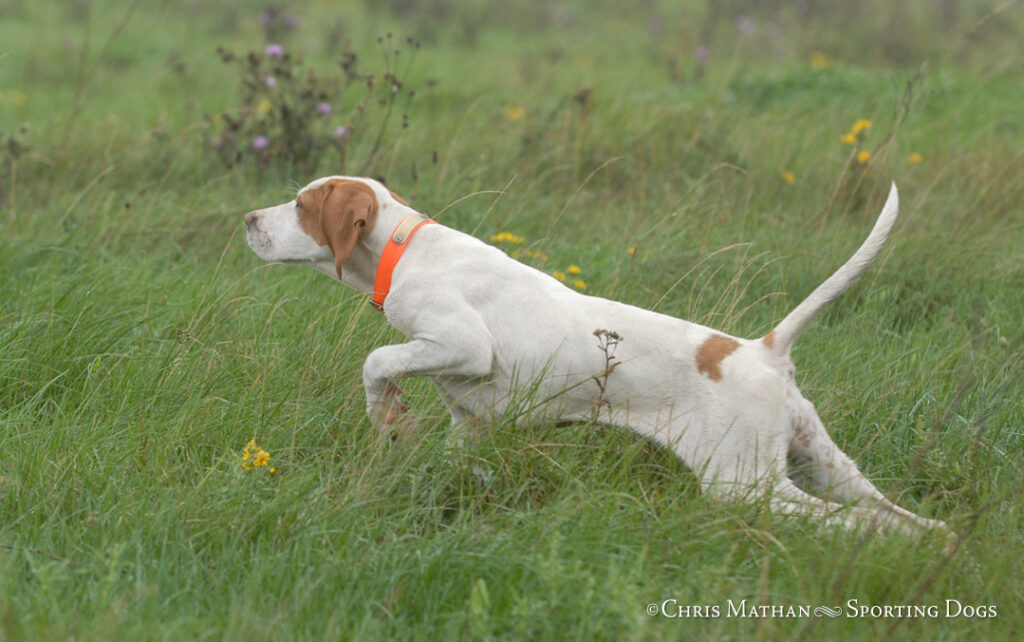
There is a long tradition of father-son apprenticeship in the pointing dog trainer-handler trade. Jake and Bobby were part of that tradition. Jake had been a for-the-public trainer-handler four decades, taught his son Bobby who scouted for him. Jake had turned his string and owners over to Bobby five years ago. Now Jake, age seventy, assisted Bobby with puppies and derbies, gave advice occasionally, sometimes welcomed, more often not.
Bobby had a son, Jake’s grandson, named Luke, age twelve. This would be the first summer Luke went with his dad and granddad to North Dakota for summer training.
Jake had one unfulfilled ambition. He wanted to give his son Bobby a National Champion. He’d had one early in his career, before the War. It gave him a credential few handler’s had, and he knew Bobby would need one day. Theirs was a dwindling business, for many reasons. To survive in it, you needed winners, and good owners that only stayed with a handler that could produce them.
Producing winners started with spotting potential which started with knowing breeders who produced outstanding field trial pointing stock. There were only a few. Jake knew them all.
When Bobby, Jake and Luke left for North Dakota July 6, they drove their two-ton truck north on a route that would take them through Western Kentucky. There they stopped at a farm and picked up a weaning-age male pointer puppy they named King, a take-off on its breeder’s nick-name among local Kentucky field-trialers. Jake had arranged the pup’s purchase.
The rest of July, August and half of September the threesome lived in a cinder block farm-worker cottage on prairie land homesteaded in 1901 by a Norwegian immigrant couple who raised nine children there, enduring weeks of -40 degree winters and rainless 100 degree summers. Jake put Luke in charge of the puppy which ran loose during daytime and slept at the foot of Luke’s bed. They became inseparable.
Luke rode with his dad and grandad as they worked derbies and conditioned and tuned up all-age dogs. By summer-end he was on the way to being a third generation bird dog man.
Back in Lee County, Georgia, Luke started school and Jake finished a half dozen derbies for the shooting strings of quail plantations while Bobby traveled with his trial string to October trials north of home in Georgia. After school Luke walked the Kentucky-bred pup King on the family farm and adjacent shooting estates where Luke also got tips as a bird boy at dove shoots on weekends.
Thanksgiving weekend the three drove to Paducah, Kentucky to attend the first renewal of a trial last held at Albany, Georgia just before World War II. It was called The Invitational and would soon become a trial every handler and owner wanted to win.
Only twelve dogs were eligible (the top twelve accepting the invitation) and they went down three days in a row (an hour Saturday and Sunday and for called-backs two hours Monday). An open all-age and derby stake followed.
Bobby had an entry in the Invitational (it was not called back for the two-hour finals) but his entry in the Invitational placed second in the following all-age stake.
Luke rode a Greyhound bus back to Georgia, leaving Paducah Sunday night and only missing Monday’s school. Bobby also won a second in the derby stake at Paducah. Jake, who had scouted for Bobby at Paducah, caught a ride home to Georgia with an owner after the derby stake.
Bobby’s regular scout, Booty Blevins, joined him in Ohio for the Pheasant Futurity and two other pheasant trials, coming from Lee County by Trailways bus. Meanwhile, back in Lee County, Jake and Luke played with King, the Kentucky-bred pup. Luke and Booty returned to Lee County for Christmas and the ensuing piney woods series of trials.
In spring King was coming a year old, and showing great maturity, a product of his constant attention from Luke. Jake knew there was nothing so good for a pup as attention from a boy. While Bobby generally did not enter puppy stakes, Jake urged him to enter King in spring puppy stakes close by home, including the Dixie Classic in Alabama.
King did not place in the Dixie, for he performed like a derby rather than a puppy, twice pointing birds with derby manners (in puppy stakes the judges were looking for ambitious range, not bird work).
Knowledgable attendees saw King’s potential as a derby and all-age and he became the talk of the sport, one to watch.
In July Bobby, Jake and Luke drove to North Dakota for summer training again. While King was a late born pup, he would by fall be derby-mature and ready for entry in derby stakes where his potential shown brightly. By Christmas he ranked third in the derby standings. Bobby decided to enter him in the Continental Derby Championship at Dixie Plantation in January.
Bobby would handle King, Booty scout, and Jake ride front. But Booty came down with flu, so Jake would scout King. Lo and behold, Jake woke on the January morning King was drawn to run with flu, caught no doubt from Booty.
What to do. Jake said, “Let Luke scout, he can handle it, and he can get King back to the front when no stranger can.”
So Luke, age fourteen, rode as King’s scout. He had in the latest six months hit a growth spurt and stood 5’ 10” and weighed 140 pounds. His voice was changing. He knew King like a favorite comic book.
Booty and Jake were bedridden with flu when King’s day to go down at Dixie arrived. Booty phoned the scout for King’s bracemate, a lifelong close friend and fellow Lee County sharecropper’s son.
“Sammy, if you ride off King this morning I will never forgive you.”
“Booty, you know I would not do that. I will help Luke if I can.”
What Booty knew was that his friend would have orders from his boss to ride off King if he could.
King went down in the first morning brace of the second day of the Continental Derby Championship, with Luke scouting, his first time in that role. He knew what to do from coaching in North Dakota by his grandfather. But he was numb with nervousness.
King’s bracemate’s scout lost his dog off the breakaway. As soon as he determined his derby was gone-too-long, he rode to find Luke who did not know the course well.
“My dog is out of it, Luke. I am going to show you this course. Keep an eye out for where I ride.”
* * * * *
King won the Continental Derby Championship with three finds and a mature race, Twice Luke was able to bring King back to the front unseen by the judges. Later he would win the 90-minute National Derby Championship run in Mississippi. Many followers of the sport had him marked for a future National Champion.
To be continued…