My history with horses is checkered. I stopped riding at field trials soon after waking up riding in Ray Warren’s pickup truck one Thanksgiving weekend, not knowing where or why I was there or who Ray was (or who I was).
I had fallen off a runaway borrowed horse at the Quail Championship Invitational at Paducah, Kentucky where I was reporting. Ray was taking me to an emergency room. Fortunately, I suffered only a mild concussion that day. The spot where I dishonorably dismounted is marked by a sign, “Tom Word’s Oak.”
My horsemanship was described graphically by Howard Wood, itinerant farrier and seasoned horseman, at Chinquapin Farm, where he came each second week of January to shoe for handlers and the public, pulling an old live-in horse trailer containing a couple of green horses he was training for sale.
Howard should have been in Hollywood, at casting calls for Westerns (Gunsmoke, Rawhide, etc).
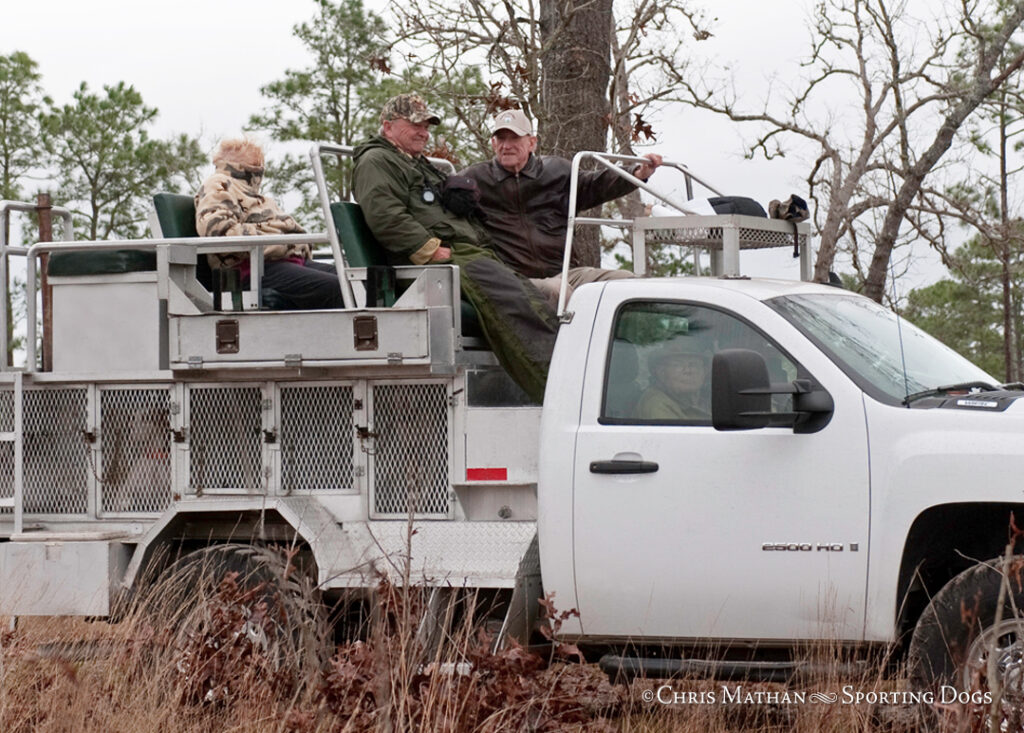
One year near the end of my horseback reporting (I graduated at Chinquapin to doing it from the top of the dog truck or on cold days from the cab where I rode shotgun to Cowboy), Howard critiqued my horsemanship thus:
“Mr. Tom, you just do not look right on a horse.”
That crushed me. My ambition from childhood had been to look good on a horse.
My father, 6’ tall and 170 lbs all his adult life, had as a boy driven from horseback, with the help of a border collie, livestock on Virginia Blue Ridge dirt roads. His father had bought the stock from farmers in his profession as a dealer.
Pops looked like Randolph Scott on a horse.
At 5’ 6” and shrinking from age, I looked…“not right,” as Howard said.
As a child I had ridden from age seven my small Shetland pony, Dixie, countless hours on farms adjoining Christiansburg, Virginia, pretending I was a cowboy. Then when I outgrew Dixie, my father bought for me Tanbark, a 16-hand Tennessee Walker gelding named for its color. I had to find a ditch to mount him, but he was smooth and gentle, though not fancy. Sadly, he went lame after a couple years as my mount. In the meantime, we had moved on Thanksgiving 1952 (I was 14) to our 130- acre farm four miles from town.
After my father died in 1954 from a car crash, and I was operating the farm with my mother’s uneasy concurrence, I bought for $125 Cordovan, a three-gaited 15.5 hand very ordinary grade saddle horse. I used him to inspect our 20 beef brood cows and 60 ewes and their calves and lambs. He was nothing special and hard to catch.
In summer, 1959, after I had finished my first law school year, I sold Cordovan to the man I bought him from for $150, $25 more than I paid for him, and used the proceeds to take my girlfriend (soon wife) to Virginia Beach for the weekend. We always jokingly called Cordovan, “the horse we drank up.”
I was horseless for a decade after law school, then after embracing weekend field trials bought Major, a field trial 16-hand Walker gelding from Alabama with bad feet, and rode him a few years. He was passable but I lacked the time from work to do him justice. At the same time, I owned Arthur, a 15.5 Walker named for Arthur Bean, who introduced me to field trials. Arthur (the horse) was really never a satisfactory field trial mount.
My next horse purchase was from Wallace Sessions, then manager of Chinquapin Farm for the Bakers. I bought a spotted Walker gelding Wallace’s wife usually rode. Wallace said he “believed” the gelding was 14 years old, but that he was not sure. Not long after, a reliable expert said the gelding was “at least 25”. I donated him to Chinquapin’s guest horse string, from which he soon disappeared.
I was horseless many years after that, then bought a well-mannered small white Missouri Foxtrotter gelding I kept on a Goochland County horse farm where I could ride it in a ring or on pasture. He was easy to catch and mannerly even after long periods unridden. One day he bucked wildly and tossed me on pasture when a fawn awakened beneath him from sleeping where its mother had left it to sleep in warm sun.
I gave this, my last horse, to handler Jimmy Edmundson with the understanding I could ride him at trials Jimmy attended. Thus ended my horse ownership.
Most of my reporting horsemanship was on borrowed mounts. If a trial sponsor tells you, “We will have two good horses for you,” do not believe it. Big George Moreland said correctly, “If it is too far to take your own horses, best not go.” Sound advice.
At Sedgefields (west), Jimmy Hinton put me aboard Snake, the retired handling horse of Charles Morton.
“This is a Cadillac ride,” I told Charles’ son who was riding as a marshal.
“Lot of miles on him,” the lad said.
Soon after, Snake stumbled and tossed me, and I landed on my forehead. Fortunately the ground was muddy. I completed my reporting that year in Mr. Jimmy’s jeep, riding shotgun with him.
At an earlier trial on state game land I had been provided the chief sponsor’s wife’s horse, a nice Walker gelding I had observed in the gallery several times before. But he was out of condition, and during the last brace of the trial he collapsed under me from fatigue. Fortunately, I managed to step off unharmed.
Among my most memorable dishonorable dismounts was at Hoyle Henley’s Montgomery, Alabama trial, held on Prather Robinson’s old training grounds in Lowndes County. Hoyle had fine horses his children rode in horse shows. It was warm and my mount tired, so I was put on a young spirited gelding. Unfortunately, I accidentally touched his flank with a sharp show spur and he took off with me with predictable results—I landed on the hard ground, dazed. Luke Weaver was my fellow judge. He and Hoyle’s grandson erected a scarecrow at the spot on the course where I was thrown with a sign saying, “Tom Word Dismounted Here.”
My most frightening reporting horse-ride was in Georgia. A pro handler was providing my mounts. He had a palomino gelding staked near his trailer. I had seen it at another trial and told him there I thought it was handsome. He had said, “If I ever put you on him you will know I am mad at you” which I thought a strange comment.
Sure enough, he led it to the first breakaway and handed me its reins. He was handling an entry in that brace. At 10, his scout called point for his dog and the judges and gallery stared to canter to the find. My handsome palomino mount took off at a full-out gallop. I held on and prayed. At the find he saw the dog and stopped abruptly. I slid off in gratitude. I handed the reins to Rick Furney, who was riding as a marshal.
“Can‘t ride him, Rick,” I said. Rick was riding the very gentle horse he saved for his owners to ride, and gave him to me to ride in exchange for the palomino. I have always been grateful to Rick for that. He may have saved my life that day. The handler providing my mounts at that trial was apparently mad at me for something I wrote in a report about one of his dogs.