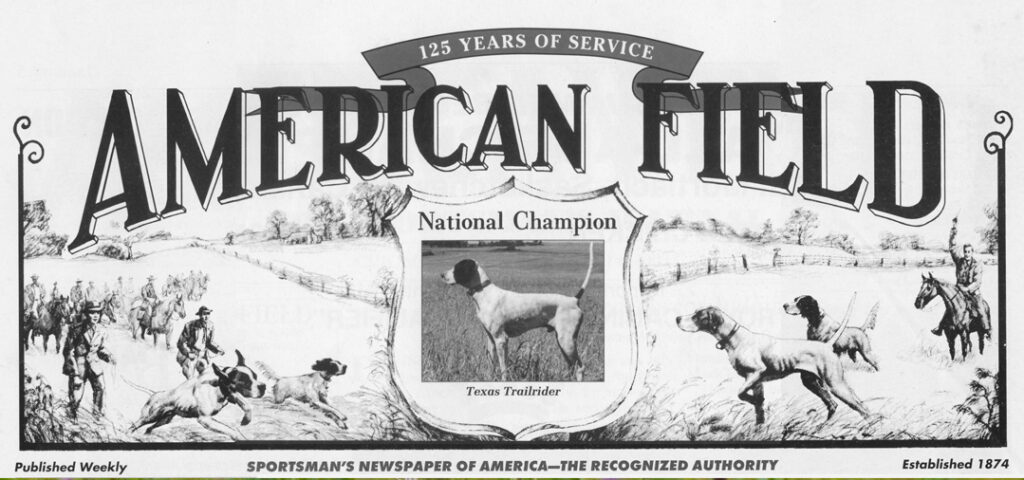
In the summer of 2003 there appeared in the venerable American Field Magazine, founded in 1874, an announcement that would shake the rafters of bird dog kennels across our continent.
Henceforth, the FDSB would require DNA proof of FDSB registered parentage to recognize a dog’s wins in FDSB sanctioned trials. The evidence required would be in the form of a cheek saliva swab, to be analyzed by a company in the business of such analysis.
In February 2004 Miller’s On Line, pointer male, won the National Bird Dog Championship at the Ames Plantation, Grand Junction, Tennessee. A swab was taken from his cheek for verification of his parentage. On analysis, it verified his sire as Miller’s White Powder, perhaps the most popular pointer sire of the day, but revealed his dam was not as represented on his registration papers submitted to the FDSB for his registration. There were threats of invalidating On Line’s win of the National. The matter was settled when the true dam’s owner, also owner of the claimed-on-registration dam, produced DNA evidence permitting correction of On Line’s registration.
End of story? Hardly. Not long after, White Powder, his owner, and all his kennel mates were permanently banished from FDSB registration eligibility and participation in the North American field trial game, open and amateur, as were all their offspring conceived after a certain date. Thus by the sweep of Bernie Matthys’ pen, White Powder and kennel mates were rendered worthless and their owner banned from future field trial competition. He chose not to contest this action or that of the AFTCA in banning him from future competition in AFTCA sanctioned trials.
Some thought the actions of the FDSB and AFTCA outrageous and unfair, including this writer. What, we wonder, did the loss of White Powder’s and kennel mates’ genes cost pointer breeders, hunters and field trialers in terms of excellence?
There is now pending before the Purina Points Committee a similar matter. It has been proposed that the current year’s open all-age points earned by a dog be erased based on the conduct of its handler toward a field trial judge. As in the case of White Powder, this dog did nothing wrong, nor did its owner, who was not present at the trial where the handler allegedly misbehaved. Surely it is not fair to punish a dog and its owner for a handler’s conduct, over which they had no influence, much less control.