With headlights out, the small black car rolled slowly up the live-oak-lined sand road toward the kennels and stables of Mossy Swamp Plantation. At 3 A.M. the only light came from a third quarter moon and a dusk-to-dawn pole light in the graveled parking lot where a dozen long horse trailers and a single dually pickup were parked. The car stopped fifty yards from the pickup, and two men in dark clothing emerged and walked to the dually. With a single plunge of a tool, the driver-side door lock was breached. Quickly the men removed the truck’s contents — jackets, raingear, a toolbox, a thick notebook — and lay them on the ground. They lifted two dog crates from the bed of the truck. Then one hot-wired the ignition while the other held a flashlight. The dually rolled out the sand road, followed by the car. The repossession was thus accomplished in three minutes, without incident, by experts in the dangerous craft.
First to discover the repossession was Leonard, the plantation’s wrangler and stableman, always the first to arrive at headquarters during trial week. “Uh oh,” Leonard said softly to himself as he saw Toby Hale’s possessions strewn over the parking lot. His heart went out to Toby as he contemplated the anguish the young handler would feel as he emerged from his trailer at dawn.
Leonard walked to the clubhouse and made a brief phone call. He returned to gather Toby’s things, placing them carefully in the back of the trailer. At least he could spare Toby the humiliation of having his peers see the stark evidence of the repossession. Then Leonard tapped gently on the door of the trailer’s compartment where Toby and his wife Polly slept.
“Who is it?’ Toby muttered.
“It’s Leonard, Toby. I need to talk to you a minute.”
Toby pulled on his jeans and boots and stepped out into the parking lot, still lit only by the halogen light on the pole.
“What’s up Leonard?” Toby asked, irritation in his voice as he looked at his watch.
“Toby, I believe your truck has been repo’d. I picked up your things and put them in the back of your trailer, moved your dog crates back behind…I’m sorry.”
Toby was fully awake. A wave of rage had passed through him, driven out now by utter despair. He had known that the repossession was imminent. But he had doused his worry with hope for a share of the purse here at Mossy Oak. Of course, he knew the odds were long, for the sixty-six dogs entered, just one in his string was left to be run. Ironically, that dog, a four-year-old pointer named Halligan’s Rip, was drawn to run in the third brace this morning, the last of the championship. Knowing that had caused Toby to stop after just two beers at the dance last night in the clubhouse, a party that now seemed to him months ago.
After a long silence, Toby said, “Thank you Leonard.” With dread he turned to go back in the trailer and explain what had happened to Polly.
* * *
Dawn came, other handlers began to arrive in rumbling trucks, and the plantation’s hands were busy tacking up the judges’ horses and their own rides as marshals. Sandy, Leonard’s wife, had coffee brewed in the clubhouse, and one by one the handlers, scouts, officials and gallery riders came in to warm themselves by the roaring fire. On the pine-paneled walls of the clubhouse, the fire-light flickered on fading photographs of bird dogs and their handlers and owners through the generations, including several of Toby’s father with Mossy Oak’s owner, Mr. Sam, and their favorite dog, Mossy Swamp Ranger, which had won the National Championship.
* * *
At 7:30 Toby walked Rip to the dog truck, opened a compartment and commanded “Load.” The big pointer vaulted three feet and turned to face Toby in anticipation of a stroke of his ears. Toby administrated it gently with a large callused hand. “Good boy,” he said softly, then carefully closed the door and inserted the safety snap. Other handlers brought the five other dogs that would compete this morning. Horse began to clatter out of the parking lot, bound with their riders for the morning’s first breakaway. Toby left Polly crying in the trailer.
Despite the weatherman’s predictions of rain, the Florida sky was blue and cloudless. The wire grass glistened like crystal in its heavy coat of frost. The sparsely set longleaf pines cast long shadows in the early morning sun.
“Are you ready, gentlemen? All right, let ’em go,” a judge said. The field trial party of twenty riders marched off on nervous mounts, the breaths of horses and riders steaming in the cold, still air. A woodpecker flitted from snag to pine top; mockingbirds and sparrows winged happily between jack oak bushes and turkey oak saplings. The steady clump, clump of hooves drummed on the sandy soil of Mossy Swamp Plantation.
The two handlers rode fifty yards ahead of the judges, chanting to their dogs as they cast through the icy wire grass in search of quail, surely still on the roost on this frosty morning. The handlers rode slowly and confidently, for the two pointers down were good handling dogs, and so the wild riding likely to be seen later would not mar this opening brace. The gallery was strangely silent, each rider absorbed in his or her own thoughts. The judges were not chatters, but serious men whose eyes were glued on the dogs or scanning the cover when the dogs were not visible. The dogs were out of sight now, but the handlers rode confidently and sang. The scouts were out on the flanks.
“Point!…Point!” came the bellowing call of Moses Jones. He was the best-known scout on the circuit, a legend at his craft for the forty years he had scouted field trial dogs. He traveled the circuit now with the grandson of the handler he had started with.
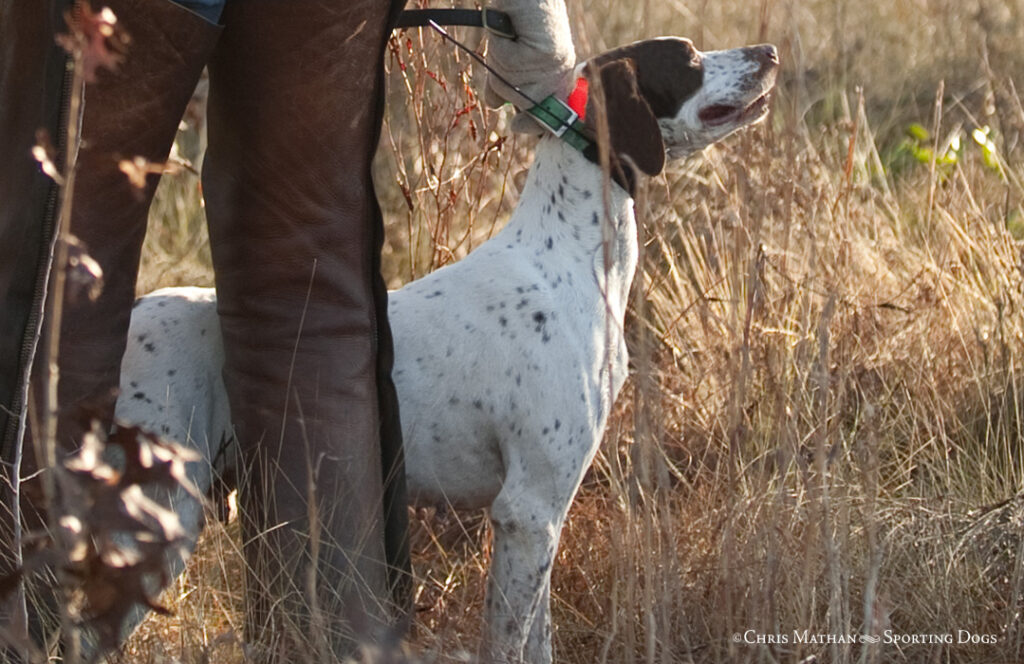
In what seemed to Toby only minutes, the first two braces were over. Each of the four dogs had a good race, scored a find or two, but he knew the trial had not been won in those braces. Now it was Toby’s one and only chance to win it. A light cover of clouds had rolled in, portending showers to come later. The young handler with whom Toby traded scouting duties met him at the dog truck; together they took Rip from his cage. Toby attached a tracking collar, gave Rip one last pat, and handed his tracker receiver to a judge to carry snapped to his saddle. He silently prayed he would not have to ask for the tracker. Fully a third of the dogs released in an all-age stake at Mossy Oak were lost before completing their hour, but Rip’s record was better. He was lost in competition only one race in six, commendable for a dog with his range, for he was a true all-age dog, not one of the pushed-out shooting dogs misplaced on the all-age circuit. He had only one fault or “hole.”
Then Toby heard the judge say, “Are you ready….Let ’em go.”
Rip was away, and Toby was absorbed in the task he loved best in his strange, arcane world of professional bird dog trainer and handler. He and his scout had plotted their strategy, discussed what they would likely need to do at each point on the course. Their preparations had been like a chess game played in their heads, with the terrain and covey haunts (known intimately from years of handling at Mossy Swamp) always in mind.
And then a magical thing began to happen. Rip was laying down a perfect race, coursing with all his speed and power in deep forward arcs through the wire grass, his path first a parenthesis on the left, then a parenthesis on the right, the perfect pattern for an all-age dog. He appeared to the judges the size of an aspirin tablet as he popped into the clear for brief moments, always reaching for the front and within the invisible “V,” responding to Toby’s calls to swing as the course changed directions. He scored a find on a covey of quail, handled it flawlessly, then another and another. Only ten minutes remained in his hour. He had it won, Toby knew, and his heart was in his throat. He must not lose Rip, and Rip must show a strong finish, show his reserve of stamina and power as the final seconds ticked away on the judges’ stopwatches.
Toby played out a mental map of the course ahead, and made the decision to bring Rip in to hunt under control for the next five minutes, then as the course approached a down-and-up section that provided a perfect vista, he would hit the whistle, and Rip would take the signal and course through the bottom and over the ridge, half a mile ahead, as time expired, all in full view of the judges. The perfect plan to end this perfect field-trial race. At least the most nearly perfect one Toby had ever seen, much less handled, in all his twenty-nine years, twenty of them spent around field trials, the last four as a professional handler on his own following long years as his father’s apprentice.
His plan went like clockwork. He heard the judge yell, “Pick him up,” just seconds after Rip topped the far ridge. He and his scout put spur to flank and tore to the front with all the speed left in their lathered horses. They had only to catch Rip now, find him within the twenty-minute grace period and show him to the judges.
Toby topped the ridge calling, “Heah, Rip, heah…” The scout rode to the left, both riders sure they would catch sight of Rip at any moment. But Rip did not show, and the minutes ticked away and Toby and his scout rode in widening circles, searching, calling, searching.
The judges sat their mounts atop the ridge and nervously looked at their stopwatches. Ten minutes, twelve, fifteen, eighteen, nineteen, only one minute left. And then twenty. They would give Rip a little extra grace time, for they wanted to reward his marvelous performance. At twenty-three minutes, the senior judge called over the chief marshal and said in a tone as sad as a priest at a funeral mass, “Go tell Toby time’s up.” The marshal shook his head.
“Time’s up, Toby.” The marshal’s words rang across the hills like a death knell. It could not be…but it was. The perfect race, the one every handler dreams of, had ended in disaster.
Toby dismounted and led his exhausted horse, heaving and steaming, toward the judges on the hilltop. They rode to meet him.
“We’re sorry, Toby, I’ll lead your horse in,” a marshal offered. Toby mounted the borrowed horse and rode in the direction of the tracker’s signal. A quarter-mile away, he reached a lime-rock sink. Buried at the bottom and hidden by the brown leaves of jack oaks stood Rip. As Toby scrambled down the steep slope, a covey roared away.
Toby knelt and stroked Rip’s shoulders.
“My mistake, ol’ boy. I should have found you,” Toby said, and slipped on the roading harness.
* * *
Polly met Toby on the sand road near the kennels, tears in her eyes to match the ones that had earlier streaked his dusty cheeks. Toby swung from the saddle and embraced her. Together they led Rip to the kennel.
Leonard walked over from the clubhouse, where everyone was gathering for lunch, and said to Toby, “Mr. Sam wants you to come by the Big House after lunch. You can borrow my truck.”
Toby still owed the entry fee for the six dogs he’d run. He expected checks to come in the mail from dog owners to cover them, care of Leonard, but the checks hadn’t come yet. If they didn’t arrive, he’d be banned from running here again. But what did that matter…his truck was gone.
Toby couldn’t eat lunch. All the handlers came up to compliment him on Rip’s race, say they were sorry he’d been lost, though the ones with a dog in contention were not. He waited until everyone was busy eating, then drove Leonard’s truck the two miles to the Big House, past the big mill pond where his father had bream fished with Mr. Sam every March, and as a boy he’d fished with them. A dozen mallards lifted in alarm as he drove over the dam, escaping through the tops of the cypress in the adjoining swamp that lent its name to the plantation.
Only Mr. Sam’s Mercedes was parked in front of the Big House. Mr. Sam opened the door just as Toby lifted the brass quail knocker.
“Come in to the fire, Toby,” Mr. Sam said warmly and offered his hand, its skin papery with age, but still firm in its grip. Toby sat awkwardly in a big wing chair facing the blazing fireplace. Mr. Sam walked to the bar and poured an inch of single malt scotch in two short glasses, carried one to Toby. Then he sat in a matching chair, and both men stared at the fire for a few minutes, which seemed an hour to Toby.
“That was one hell of a performance, maybe the best I’ve ever seen at Mossy Swamp,” Mr. Sam finally said.
“Thank you, sir.”
“Too honest, your daddy would have said. I can hear him now. If a dog has got to have a hole — and every dog does — I guess that’s the best one.”
“Yes sir, that’s what Pop would have said. Rip won’t leave a point or run up his birds as long as the birds stay. I should have checked that sink closer. I rode by it twice looking for him.”
“Don’t blame yourself. It’s just one of those things that happen in field trials, always has, always will.”
They sat a while longer in silence, sipping their scotch. Then Toby said, “Mr. Sam, I haven’t got the money for my entry fees.” He was utterly ashamed and his voice betrayed it.
Mr. Sam was silent a while longer, staring at the fire. Then he turned his face to Toby and spoke, his expression changing from grave to the smile Toby remembered from the days when his father handled Mr. Sam’s dogs on the circuit, brought him here to Mossy Swamp to fish, later to scout.
“Toby, I need a dog trainer here at Mossy Swamp. I’m offering you the job. I offered it to your daddy a dozen times, but he loved the circuit too much. You can handle a couple of trial dogs for me in trials around here, one trial a year on the prairie when you finish summer training of the shooting string — as long as you’ve got that string broke first to my satisfaction. I’ll advance you enough to cover your entry fees.”
Before Toby could respond, Mr. Sam motioned for Toby to follow. They walked out on the deck overlooking Mossy Swamp. Parked in the back driveway was Toby’s truck. Mr. Sam had bought Toby’s note from the bank.
“You can have your truck back for a half interest in Rip,” Mr. Sam said.
“You’ll have to talk to Polly about that,” Toby said with a grin. (The dog was hers, a gift in the will of its original owner who until recently had been Toby’s best customer.)
Author’s note: This fictional story conceived at the 2001 Florida Championship, is dedicated to the staff of Chinquapin Farm and especially to Leonard Craig whose gentle kindness inspired its character of the same name.
This is posted in memory of Sandy Craig, wife of Leonard, who died recently after a long illness during which Leonard nursed her faithfully and well.
Well said Mr. Tom, very well said!
Tom, I sure enjoy your writings and one of your books.