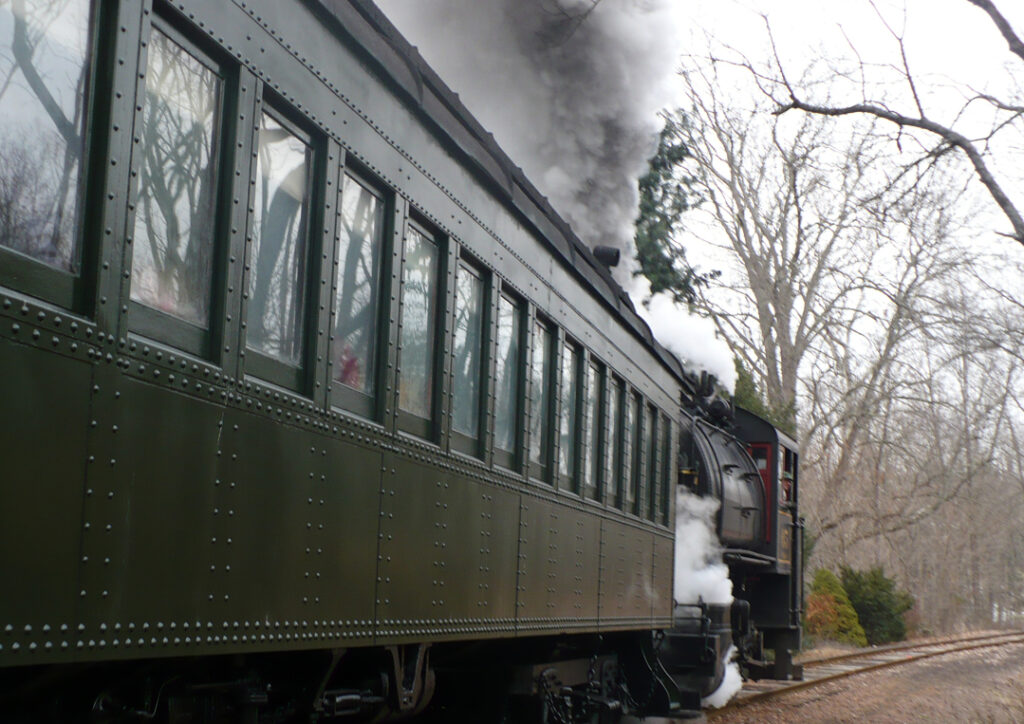
I never see an image of a railway baggage wagon without it triggering a movie in my mind. The setting is the Norfolk & Western Railway Passenger Depot at Cambria, Virginia. The year is 1944.
I am there with my father. I am 7 years old. My father is there to collect any incoming mail addressed to his law office arriving on the soon arriving west-bound passenger train.
We are inside the passenger waiting room, filled with wooden bench seats for persons waiting for a train to board or to meet an arriving passenger.
In the northwest corner of the room is the passenger agent’s office, 20’ by 20’ with glass walls above three feet of wood and an opening with no glass through which the agent dispenses paper tickets stamped by him in ink with a destination.
His office holds a 10’ X 10’ desk and behind it the agent’s swivel chair. The office is meant to have only one person in it, the passenger agent, dispensing tickets through the hole in the glass to passengers standing in the waiting area.
It is early evening, just turned dark. The passenger agent is a friend of my father named Jones, nicknamed Generosity by my father as a tease for his tightness.
On this night a family—father, mother, two early-teen daughters—is seated together on a bench in the corner farthest from the agent’s office. They are silent. The room is dimly lit.
They are waiting for a train. The train is carrying, in its Railway Express car, a casket containing the remains of the son of the couple, a victim of combat in Europe or Asia, I do not know which.
I am in the agent’s office, playing with the many stamps he uses to stamp destination names on passenger tickets.
My father walks silently over to the family, whom he knows, shakes the man’s hand and talks quietly to them a few minutes, then walks back to the agent’s glass-enclosed office.
We hear the steam whistle of the train approaching from Roanoke, then its loud rumble on the tracks, then the clang of its bell as steam escapes through valves and it slows to a stop opposite the depot. The Railway Express car stops directly opposite the door of the Railway Express Office, just west of the passenger waiting room.
The family rises to their feet and walks out of the waiting room onto the platform as the train rolls in. They stand huddled together opposite the express office door as it slides open. A clerk pulls a four-iron-wheeled baggage wagon out of the storage room and maneuvers it snug against the opened Express car door.
Four men in the Express car carry a casket by its corners to the car’s open door and place it carefully on the baggage wagon. The wagon’s top is exactly level with the floor of the Express car. Then the baggage wagon is pulled fifty feet by the clerk across the asphalt platform to a waiting black Buick hearse, its rear door open to receive the casket, its motor idling, light gray exhaust smoke puffing from its tail pipe. Its driver, clad in dark suit, white shirt and silver tie, stands beside the hearse, prepared to help the express clerk place the casket on the rollers in the hearse’s floor.
The only sounds are from the baggage wagon’s iron wheels rolling across the asphalt and the steam escaping the train’s engine. On the hearse’s sides appear in silver letters: Richardson’s Funeral Home.
The casket rolls smoothly from the baggage wagon into the hearse on the rollers and the driver closes its rear door, slips behind the wheel and closes silently the driver-side door.
The soldier’s family has watched from the platform and now walks to their black four-door 1936 Ford sedan parked nearby. The daughters take the rear seat, the father climbs behind the wheel and the mother enters through the front passenger-side door.
The hearse pulls away, followed closely by the soldier’s family. My father drives us in his 1940 faded maroon Chevy two-door sedan, following the hearse and family over the steep hill to Christiansburg’s Main Street where the hearse and family pull into the funeral home’s parking lot. We drive south two blocks further to our home at 300 West Main Street.
My father had served on the Draft Board that denied the soldier a draft deferment. He does not speak after we enter our car at the depot.