T’was in a time when men (and sometimes women) from small towns in our region were often competitors, and rivals, in whatever engaged them, be it commerce or profession or sport, or all the above.
In the town concerned in this yarn, an adjoining place was a military base, a large training area called “Fort X” or “Camp X” depending on the decade, but the same Defense-Department-owned ground, named for the same long-dead Confederate Commander, the “X”.
(Recently the X had been changed to the name of a Union soldier but changed back to a Confederate one by the current administration).
The Fort or Camp had sufficient extra ground in it to support a native wild quail population that accommodated three hours of bird dog field trial courses and on these the townsmen (and occasionally townswomen) engaged their sporting rivalries, so long as the current base commander was a quail hunter or bird lover which fortunately was almost always in the decades concerned in this yarn.
As in most towns this size, there was a Ford and a Chevy dealer, two funeral homes, two lawyers and two CPAs, plus numerous church leaders of varying denominations, titled pastor or minister or priest or deacon or father. Each was a competitor, or rival, of the other. And because Fort or Camp (depending on the decade concerned) “X” had long ago become a bird dog field trial site, these rivals in business or profession had become field trial rivals.
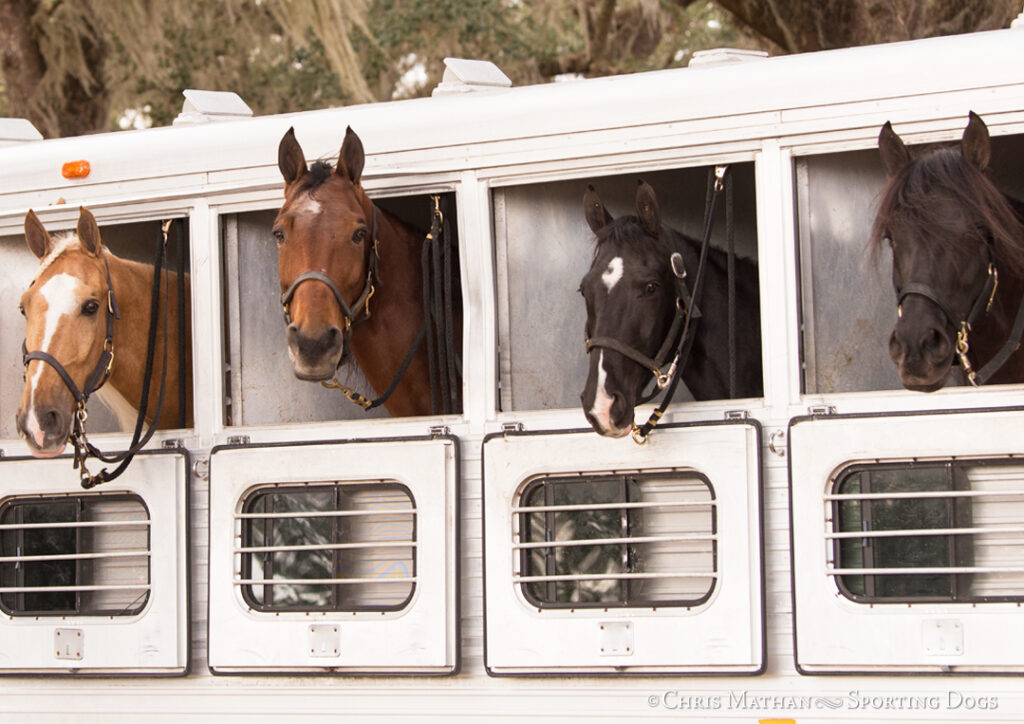
Where there were field trials those involved always coveted good field trial mounts, Tennessee Walkers or Missouri Fox Trotters that could carry handlers or scouts or dog owners or their wives or husbands or girlfriends or boyfriends or children smoothly on the courses. There had always been envy and jealousy about field trial mounts among field trialers, especially so at the place concerned in this yarn.
Trading of field trial mounts was about the last vestige of the great American tradition of horse trading. All was fair in horse trading, always had been. And in the town adjoining Fort or Camp “X”, doubly so. To best one’s rival in a horse trade was equivalent to winning first in a top trial stake on Camp or Fort “X”.
In the mid 1950s a new element was introduced into the game of horse trading, an injectable tranquilizer called Acepromazine or “Ace”, a miracle drug sometimes called “cowboy in a bottle”. An injection of it in the neck of a bucker or kicker or runoff would for a time turn it into a docile gentleman or lady. That time varied horse by horse, depending on size or weight mostly but not easily judged. It was possible to overdose. In a famous case, an aged Field Trial HOF member intending to ride a mount at Hoffman dosed it with ACE only to have his nephew, a veterinarian and later a HOF member himself, come behind him and give it a second dose, resulting in the mount lying down for a long nap beside the horse trailer it was tied to.
It so happened that the week before the Virginia Amateur Field Trial Association’s annual one-hour Amateur All-Age Stake was to be run at Camp “X”, the sole Veterinarian in the town adjoining told both funeral directors of the town about Ace.
Each of them had recently been sold a smooth, handsome and stylish supposedly gentle horse that, un-Aced, was a hellion. Each now understood that the mount he had acquired had been Aced when he tried it out. And each decided that at the Virginia Amateur hour trial he would trade his hellion to his competitor in the funeral home business.
It so miraculously happened that the trades were concluded early in the morning they would compete as bracemates in the one-hour Virginia Amateur All-Age at Camp “X”. Each had ridden the mount he traded for early that morning in a test ride when it was freshly Aced. But when they turned loose their dogs in the third brace of the stake, each mounted on his new mount, all hell broke loose. Each was thrown mid-heat. Neither could catch his new mount. So his entry got an X in the judges’ books. Fortunately, neither was seriously injured.