Nineteen fifty to 1960 were my farming years, the first three years and two months as my father’s partner. (He also practiced law).
On June 29, 1950 I turned twelve, and on that day my father bought for $1200 a John Deere MT tractor for me to operate, retired our draft mare team Maud and Bird, and fired our resident farm tenant.
The tractor dealer, Nelson Wimmer, to whom my grandfather had given in 1934 a seed and fertilizer retail business he founded in 1919 that never made money, converted it to a John Deere dealership that prospered many decades.
It took Mr. Wimmer’s employee a half-day to teach me to operate the MT, a condition of my father’s purchase. I still marvel that my father trusted me at that age to operate the tractor on our steep Blue Ridge farmland. You can view the farm on a drone You-Tube video Word Farm Riner Virginia.
My father died from injuries in a car crash February 24, 1954 when he was 56 and I was 15. From then to May 1960 my mother and I continued to farm. She bravely let me manage and work it while attending high school and Virginia Tech as a day student, and in summers to the end of my second law school year.
Then we sold the livestock and cash rented the farm land to a neighboring dairy farmer for just enough to cover property taxes and insurance. My mother and sister Mary Ann continued to live on the farm in the hilltop one-story house built from remnant limestone from Fort McDonald by my parents in 1951-52, until my mother’s death in 1999 at age 97.
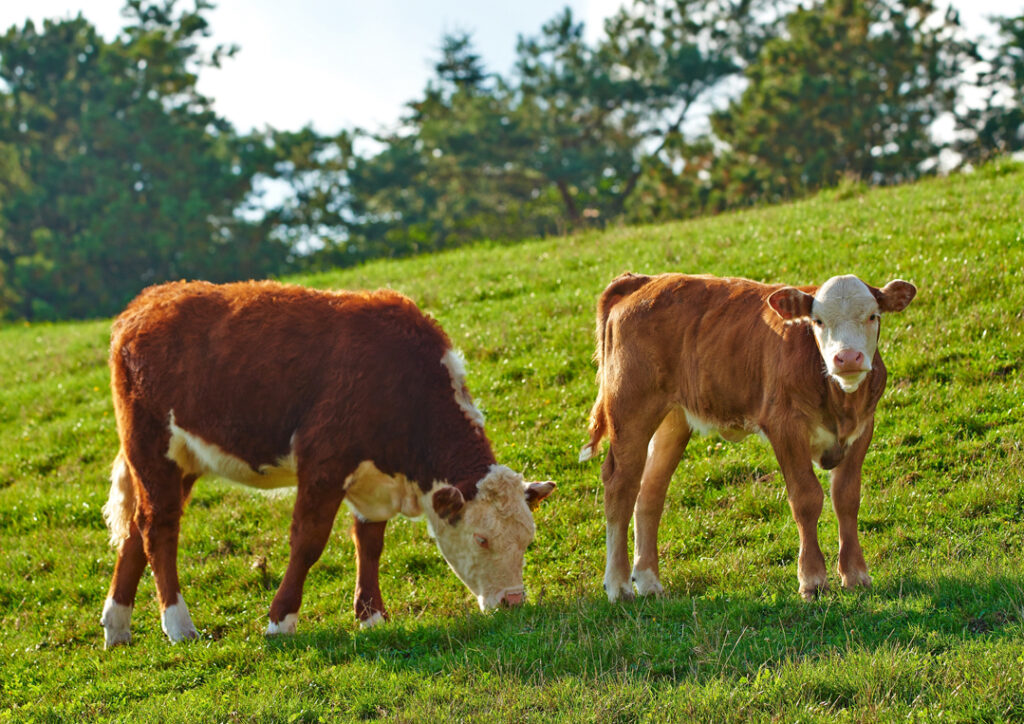
The farm was 130 hilly acres in Montgomery County, the front (south) 40 (the least sloping) growing alfalfa hay, the other 90 of bluegrass and white clover pasture. On it we kept 20 grade Hereford brood cows and 60 grade Hampshire ewes, producing each year about one calf per cow and 90 lambs (or 1.5 lambs per ewe). About every other ewe bore twins.
We bred the ewes to start lambing Christmas Eve and the cows to calve in spring. We harvested three or sometimes four cuttings of alfalfa hay yearly, enough to winter our stock and sell a third or fourth of the crop, its volume and quality dependent on spring and summer rainfall. The hay sold for 75 cents to $1.25 per bale, depending on demand, depending on scarcity, depending on rainfall.
I mowed, windrowed and hauled to the barn the alfalfa on a custom-made trailer pulled by the MT, while a neighbor custom baled it for 15 cents a bale. We hired my schoolmates to load the bales on the trailer and help me unload them in the barn loft, wages 50 cents an hour. Mr. Harris, a retired dairy farm manager, served as my mentor in exchange for use of the MT on his small farm nearby.
I fed the livestock fall and winter, hauling hay daily on the trailer to steep spots on the pasture so the stock’s manure and urine enriched the grassland where most needed. My favorite duty was tending the lambing barn at night from Christmas Eve through February. There I performed as a midwife, a skill taught me by my father. About one ewe in three required assistance in lambing. All got fresh straw underfoot, a bucket of water and two bats of fine third cutting alfalfa as rewards for lambing.
I have never felt more worthwhile as a human being than while walking home through snow from the lambing barn after a night’s midwife duty. Mother always had a breakfast of scrambled eggs, bacon, grits and biscuits waiting. I can smell it now as I write this 70 plus years after.
Was I a good farmer?
Truthfully, no. I made many mistakes, learning painfully from them. I allowed the sheep to develop foot rot, a nightmarish condition I fought by trimming hooves and bathing their feet in copper sulfate solution.
I faithfully dosed the flock for worms but worms were always a problem. I learned painfully the benefits of dagging to prevent maggots. I entered sheep shearing contests but was too short (and weak) to be a first-class shearer as I longed to be.
Despite these difficulties, we managed to ship to market in May lambs weighing 90-100 pounds and mostly grading Choice, marked at the stockyard (or sale barn) with one blue circle on the back.
I was very fortunate to have as a friend and instructor Jake (HH) Shelburne, a master sheep farmer and USDA and Virginia Department of Agriculture livestock grader. He taught seminars on livestock grading at Land Grant colleges all across the country. He graded at sale barns in Montgomery and other nearby counties (Wythe, Pulaski, Floyd, Roanoke included).
He helped me find replacement yearling ewes and good rams for breeding and advised me about dosing and other medications. I loved to go with him to sale barns to watch him grade lambs, calves and other livestock trucked in by farmers for sale. He was an artist at the craft.
My most persistent problems were with the cows and calves. They developed warts and pinkeye, a real problem in hot, cloudless spells and difficult to treat. I recalled from Sunday school the Plagues of the Egyptians, especially number five, from Exodus 9:1-3, “the hand of the Lord will bring a terrible plague on your livestock in the field…on your cattle and sheep…” Still, we managed to sell each year lambs and feeder calves we were proud of, mostly grading Choice.
Our biggest farming heartbreak came when ferrel house dogs attacked our sheep flock in the night. One morning I found in our small front pasture a dozen ewes with strips of skin and wool ripped and hanging from their necks and sides, a death sentence. House pets allowed to run free at night gathered and hunted in packs for sheep flocks like ours to attack, then return home before sunrise. Their owners never suspected their crimes.
I became a nocturnal dog hunter, driving the secondary roads near us with my single shot Iver Johnson 12 gauge loaded with buckshot beside me. But the gangs of marauding dogs were stealthy, lethal, and relentless. I could never catch them at their crimes.
I reflect on my farming days with deep gratitude. Farming taught me a work ethic, appreciation of nature, and the value to body and soul of physical work.
The Kentucky author and poet Wendell Berry has captured the magic of the sort of farming we did in his Port William series of novels and short stories, wonderful reads for anyone contemplating or remembering farming.