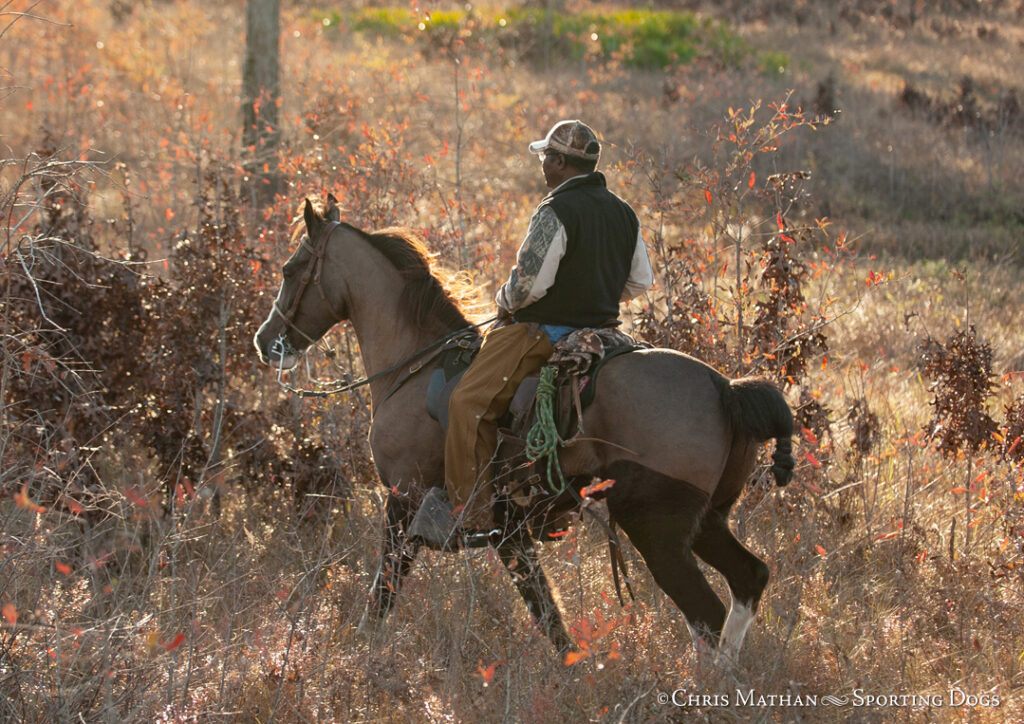
This year there were only two in attendance at the Championship, held in North Florida the second week of January. Five decades earlier, when the trial was first held in 1969, each of the handlers attending had one, a year-around full-time employee. I speak of black scouts. The handlers were all white, then and now.
The employee-scouts had mostly been replaced by a new system, adopted because of economic necessity. Instead of employee-scouts, handlers scouted for one another, the system called “helpin’ each other.” It saved money, on scout pay and horse costs.
The two black employee-scouts worked for aged handlers, long in the game as professionals. The younger scout (named David) was sixty and worked for a handler who worked for but one dog owner, a wealthy heiress whose father had been the handler’s first employer. The older scout (named Moses) was seventy-five and worked for a for-the-public handler who handled dogs for five different dog owners. The two scouts were dear friends, though one lived in Tennessee, one in Alabama.
The Championship was now a two-series event, with 40-minute qualifying heats and one-hour finals, the finals dogs of whatever number the judges wanted to see for an hour. Usually that number was however many could be seen in the hours of daylight available after the qualifying 40-minute braces ended plus one additional six-brace day. This year the qualifying heats ended at the end of Thursday, and the judges called back twelve to go in six braces Friday. Forty dogs had been entered.
Two of the called-back dogs would be scouted by David, one by Mose, whose dog would go in the last call-back brace. Mose’s dog was a first-year all-age which had won not one placement in the current season. It had been a top derby the season before. It was a big running dog, often needing to be found by its scout. Its name was Heartwood.
This season was proving difficult for Mose. David thought he knew why, and how he might help Mose. He would ride front for Mose’s last-brace dog in the finals, named Heartwood.
At the lunch break on the final day, David found Mose at the paddock assigned to Mose’s employer for his and Mose’s mounts.
“Mose, what horse you going to ride to scout Heartwood?” David asked.
“I’m trying to decide. My good scout horse Silver—you remember him—I retired last year. I don’t have an experienced scout horse to ride,” Mose answered.
“Why don’t you ride my Cisco?” David said.
Mose grinned. “Can I? Your boss is not going to like that.”
“We have not got a dog in contention. He will not care.” David said.
And so Mose scouted riding Cisco, a scout gelding that would look for a dog he was scouting and see it always, whether pointed or moving, before its scout-rider and signal the fact to that rider.
In the last brace, Cisco and Mose found Heartwood pointed on two limb finds, and Heartwood was named Champion.
What David had sensed was that Mose’s eyesight was failing with his age, and without a scout horse that looked for the dog he could no longer do his job. After the trial finished, David had his boss talk to Mose’s boss to be sure Mose would get a first-class scout horse to scout his new Champion from.
Author’s note: This story is fiction, written in honor of David Johnson, HOF, a scout who helps everyone at a trial.