Arnie Eanes and Bo Brown were a handler-scout team of the 1930s, home based in Georgia. Arnie was white, Bo black.
They lived at a time and place when almost no one had wealth, and the few who did were from up north and loved to bird hunt and admired good pointing dogs.
Arnie and Bo made their meager income training and handling those dogs, for competitions called field trials. This was a sport invented sixty-odd years before in England and imported to the United States in 1874 and since become popular among a few sportsmen, wealthy and not, across the nation.
Clubs sponsored the trials on the same days each year. A few of the trails became fixtures on sporting calendars, foremost the National Bird Dog Championship held the second week of February at the Ames Plantation, Grand Junction, Tennessee, and hosted by Hobart Ames, son of Congressman Oakes Ames of Massachusetts, mastermind of the Credit Mobilier scandal engulfing the building of the transcontinental railroad and CEO of the Ames Shovel Shop which grew rich and powerful supplying 49er gold prospectors and earned him the derisive nickname, King of Spades.
Hobart Ames judged the trial and set its standards. His chief rival, AGC Sage, a lumberman of New York City, sponsored a rival club, the National Club, which sponsored the National Free-For-All Championship and National Derby Championship, where wider ranging dogs were deemed ideal. For many years the two men remained quiet rivals, and dogs sponsored by Sage regularly won both Clubs’ trials.
Arnie and Bo were so-called “for-the-public” handler and scout, working for multiple owners and not at major circuit trials. They won some, lost more, but survived on a reputation for hard work in this time of a Great Depression, when all but a few folk lived in economic desperation, sustained by what they put up from vegetable gardens or small farms.
In January of 1933, with America’s unemployment rate at 24.9%, Arnie and Bo lucked onto a super-talented pointer derby named Superboy, bought from the North Carolina tobacco farmer who bred him. That farmer knew nothing of field trials. He knew the young dog could hunt like the wind and find, point, hold and retrieve quail with a soft mouth reliably whenever taken afield.
Tobacco farmers were ideal bird dog breeders and starters because their work was seasonal and they had time in late fall and the environment for it and quail were plentiful in their patchwork farming country, not yet spoiled by fescue and bush-hogs and big machinery farming.
The breeder of Superboy needed cash for seed to plant for the year’s tobacco crop and for that reason only sold Superboy to Arnie for $300, a long sum for that desperate time.
Who do I place Superboy with, was Arnie’s consuming worry from the day he bought Superboy. It must be someone who will not take the dog away from me and Bo and place him with another handler, or fail to pay his training fees, entry fees or vet bills.
Arnie had experienced all these calamities more than once. Especially since things fell apart in ‘29. Most of the Big Sports disappeared then, except the Oil Boys, and Edward Farrior, Ches Harris, Prather Robinson or Jake Bishop had most of them. The likes of Walter Teagle, president of Standard Oil of New Jersey, better known as Esso, and LD Johnson of Indiana, who was Ed Farrior’s man.
Then there were the baking boys, Raymond Hoagland and U. R. Fleishmann, heads of Royal Baking Powder and Fleischmann Yeast. Their products were needed in every home, even in this awful depression, so they still prospered and sponsored dogs on the major circuit.
Arnie and Bo did not go north for summer training, but word got around that they had a derby worthy of prairie competition. The few multi-millionaires sponsoring trial dogs were always looking for that kind and, knowing Arnie did not rank with their handlers, thought this might give them a chance to pick up a good derby.
Walter Teagle telegraphed Arnie (Arnie had no telephone so he could not be called) and asked Arnie to call him collect, which Arnie did from a pay phone in a drug store.
“Hear you got a nice derby, Mr. Eanes,” Teagle said when his secretary and Esso’s PBX operator connected Arnie.
“Yes Sir, but he ain’t for sale.”
“Even if the buyer left him in your string?”
“For how long?”
(Arnie knew that Mr. Teagle sometimes bought derbies and left them with their developing handler through the derby season, then moved them to Prather Robinson or Ches Harris to run as an All-Age, it they made it, which few did).
“I’m not interested in developing dogs for other handlers to beat me with,” Arnie said.
Teagle admired Arnie’s grit.
“Tell you what, Mr. Eanes, we are short of entries for the All-America Derby up at Pierson first of September. I’ll send you money for train tickets for you and your scout up and back and pay you derby’s entry fee. You win anything you keep it.”
“Anything else I can run in while I am up there? “
“There is the All-Age, and the Chicken Championship if he’s eligible
Arnie did not know where he would get the entry fee for the All-Age —Teagle had not offered to pay that. And Superboy was not eligible to run in the Chicken Championship.
“Let me see if I can arrange to get away. And thank you, Mr. Teagle,” Arnie said, and hung up.
Neither Arnie nor Bo had ever been to Canada. Superboy rode in the baggage car but the conductor let them go back and visit him whenever they wanted. Until they got north of the Mason-Dixon Line, Bo had to ride in the back in a Jim Crow car, then he came forward and joined Arnie. They rode in coaches, not Pullmans, so slept sitting up. The trip took four days and took them through Chicago, Minneapolis, Bismarck and Minot, finally to Antler, ND where they crossed the border into Canada. Pierson was a train stop nearby.
Bo’s wife, an excellent cook, had fixed them meals to last the whole trip which they carried in a wicker basket Bo’s wife had weaved. Arnie could not remember eating so well (he was a bachelor and cooked for himself, mostly beans and salt pork).
Teagle had Prather Robinson meet them in Antler. Prather was the younger brother of Ches Harris’s wife and Prather and Ches shared training grounds at Letohatchee, Alabama and worked together in summer near Pierson.
Prather had been having success with Teagle’s dogs and it continued at Pierson. He won first and second in the Derby with Norias Boy Jr. and Norias Esso. Superboy would have won fourth if they had awarded one, which they did not.
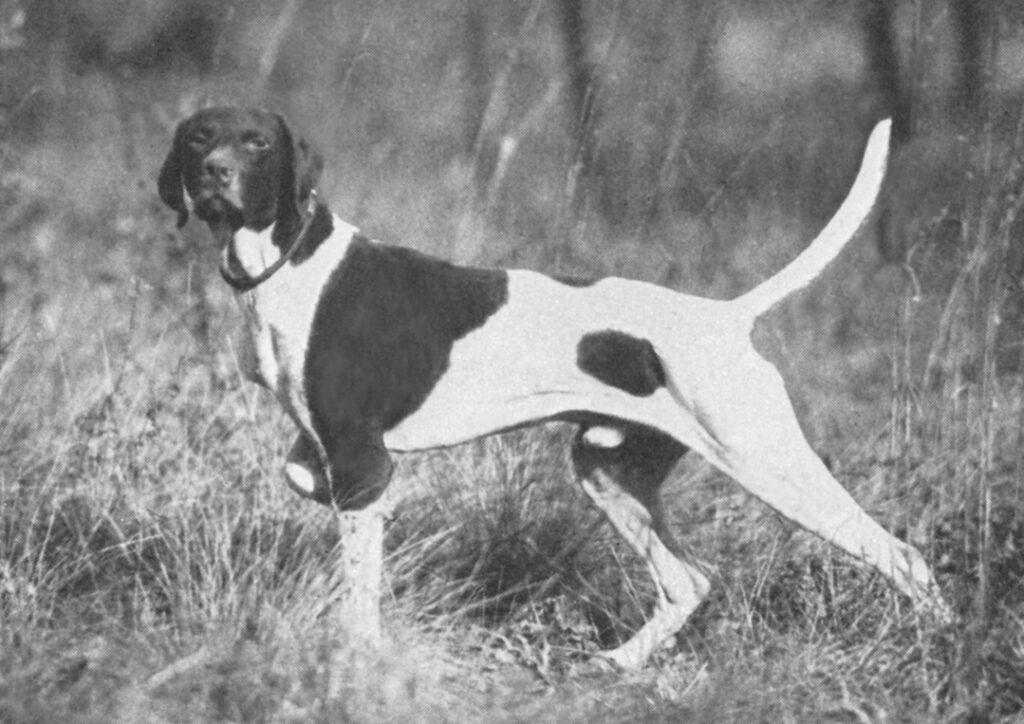
Then Prather won the All-America Open Chicken Championship for Teagle with Norias Roy, which made Teagle very happy.
During Arnie and Bo’s time at the All-America prairie trial at Pierson, Prather became very fond of Bo. He told Teagle:
“Mr. Teagle, you should hire Bo and Arnie for your Norias Plantation, and Superboy would make the ideal head of your shooting string there. He is a super bird finder and has perfect manners, and so does Bo. He can be your butler at night and mix drinks for your dinner guests and guide hunts during the day. Let Arnie and Bo run Superboy in the Quail Futurity in Oklahoma before shooting season starts at Norias.”
Teagle did just that. Some said Superboy should have placed in the Quail Futurity, but he had too many finds for the sort of race the judges were looking for. Instead, Prather Robinson won first and second for Teagle with Norias Esso and Norias Essolou.
Then Arnie and Bo and Superboy returned to Norias Plantation, then owned by Teagle with his long-time friend Walter Edge, New Jersey Governor twice, US Senator and Ambassador to France. Later Teagle would buy out Edge and Edge would buy 18,000-acre adjoining Sunny Hill Plantation from the estate of Colonel Lewis S. Thompson. Norias had been carved out of Sunny Hill in when bought by Teagle and Edge.
Both Teagle and Edge had sinister sides to their illustrious resumes. Teagle as Chairman of the Board of Esso had supplied petroleum to Hitler. Edge as Ambassador to France had played a part in the crafting of the Treaty of Versailles after WWI, its harsh terms leading to Germany’s ruinous inflation and the rise of Hitler.
The name Norias was appropriated by Teagle for his trial dogs and by him and Edge for their Florida quail plantation from a Texas train stop on the Missouri Pacific Line where they had previously quail hunted together.
Noria is the Syrian name for ancient giant waterwheels engineered as early as 700 AD to raise water from a stream to an aqueduct above.
Photo: Norias Roy
Author’s note: Arnie, Bo and Superboy are fictional characters and their story is fiction. But the settings and other characters are real, as are Teagle and Edge’s roles in history and Teagle’s in field trials.