My father’s life was a continuing battle with failure. He was sustained in his struggles by a sense of humor.
Born in 1897 to an Appalachian farmer-livestock trader father and a direct descendant of Shawnee abductee Mary Draper Ingles mother, his formal education ended with high school, from which he did not graduate.
In 1915 he bought in partnership a livery stable in Christiansburg, Virginia, its business ferrying drummers between the Cambria train depot and the hotel on Christiansburg’s courthouse square. Alas, Henry Ford’s Model T quickly felled it. Its assets were auctioned for creditors May 1, 1917 on the courthouse steps.
Soon drafted for WWI, he earned by tests a chance for an officer’s commission at Fort Zachary Taylor in Kentucky. Earning first in his officer candidate class, a Lieutenant’s commission was awarded to him on Armistice Day, November 11, 1918. He was immediately discharged.
Back home, he was offered equal and managing partner role in the 777-acre Walters Farm by the county’s supposed richest man, a fabulous opportunity. The partnership would buy the farm in January 1919 for $37 an acre. It lay on the headwaters of the Roanoke River, which flowed through its length. Terms were $1000 cash down, the rest due in five years on seller financing. The farm today is bisected by the Virginia Tech Smart Road — you can view it on Google Earth.
Nineteen-Nineteen was the Nation’s best-ever year for farming. Land values climbed to a national average $69 an acre — $200 an acre in the Midwest. Livestock and other agricultural commodity prices rose commensurately. All because Europe was starving. But alas, in 1920 Europe recovered, and these prices plummeted.
In 1922 my father’s partner, Colonel (honorary) Sidney Sheltman, died of influenza, the pandemic scourge of the WWI Doughboys. In a week, Sheltman’s empire crumbled into receivership, including the 777-acre Walter’s Farm, a Ford dealership, sawmills, timberlands, other farms and suburban land held for development.
Not a cent had been paid on the Walters Farm purchase debt. Walters took the farm back with his vendor’s lien. Fortunately, Walters did not pursue my father for the deficiency.
Sheltman’s widow and children got nothing from his estate; his creditors got pennies on the dollar, long deferred.
Afterwards, my father always said, “Partnership is an instrument of the Devil, and seven is not our lucky number.”
Broke, my father took up life insurance sales and moved to Birmingham, Alabama, just emerging as the Pittsburg of the South. Taking a room in a boarding house, he was introduced by its female owner to my mother, teaching math and music in elementary public school. Her mother, long a widow and a friend of my father’s landlady, also ran a boarding house with two maiden sisters, theirs for female school teachers. Operating a boarding house was then among the few ways poor widows could respectably support their families.
My parents married in 1925 and moved to Bradenton, Florida, just north of Henry Ford’s and Thomas Edison’s winter enclaves. Florida was enjoying its first land boom. My father made $4000 selling life insurance in 1926, the best financial year of his life. He paid $3.96 in federal income tax — I have his tax return.
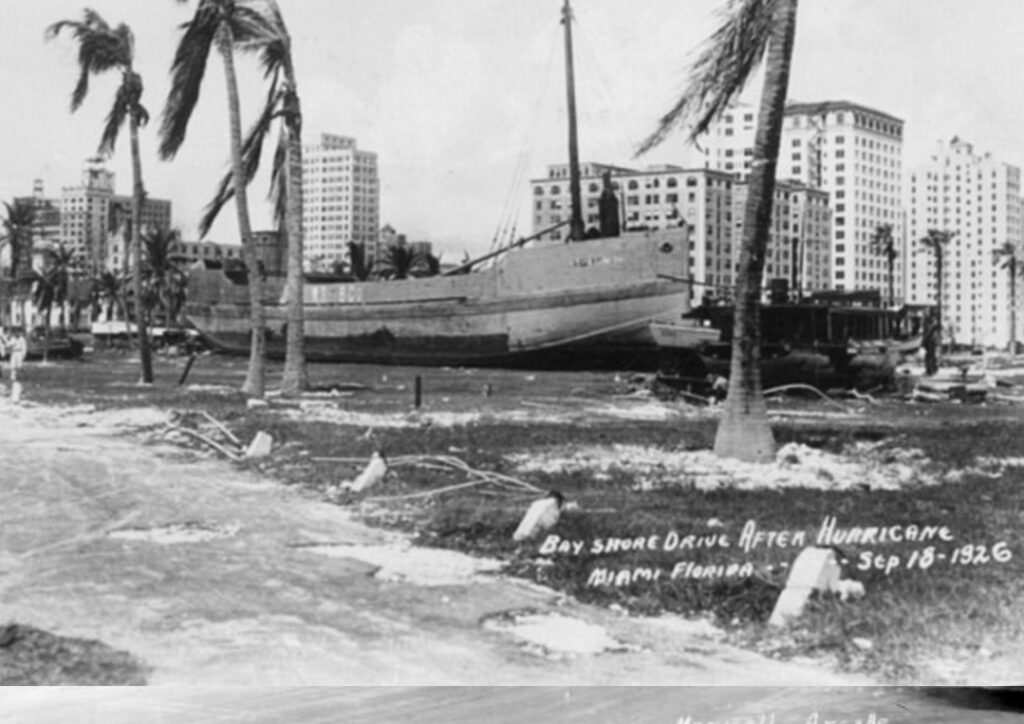
But then October 1926 brought The Great Miami Hurricane, killing an estimated 372 to 539 people — population numbers of migrant workers were impossible to track. It inflicting $235 billion property damage (in 2018 dollars).
The storm passed east to west across the southern tip of Florida, then swept northeast through the Gulf to rake the state’s west side, striking land again at Pensacola. The hurricane proved the Florida land boom a bubble.
My father’s life insurance business collapsed. In 1929, he and my mother retreated to Christiansburg, broke again and jobless. My mother stopped off in Birmingham to give birth to their first child, Mary Ann, on February 5, 1929. The stock market crash followed in October.
Before leaving Florida, my father’s love of all things agrarian had led to another financial disaster. He bought 500 grade Marino ewes and shipped them by rail to my grandfather to be grazed on mountain bluegrass pastures. When they did not arrive on schedule, my grandfather telegraphed, “WHERE SHEEP,” prompting a frantic search. Alas, the sheep had been seized by animal health officials in South Carolina in a hoof and mouth disease scare and destroyed. They were not insured.
Back in 1919 Sidney Sheltman had inflicted other damage to our family. He had bought my grandfather’s 250-acre farm for $50 an acre, half cash, half for his note. The note, held by my grandfather, went unpaid in his receivership but remained a lien on the farm. The purchaser of the farm from the receivers finally paid it off — but not until 1942!
My grandfather had used the cash half of his farm sale to found, in 1919, Christiansburg Seed & Fertilizer Company. It never made a nickel, for in Appalachia the Roaring 20s were an agricultural depression, followed by the Great Depression, lasting through the 1930s until WW II.
My father tried to save the seed and fertilizer business on his return from Florida by traveling the state in a Model T selling, but to no avail. In 1934 my grandfather gave the business (but not its debt, endorsed by him and my father) to Stanley Wimmer.
Wimmer converted it to a John Deere dealership that prospered grandly for generations.
In 1931 my father was broke again and jobless. But finally a piece of good luck came his way. The Clerk of the Montgomery County Circuit Court died.
The circuit judge would appoint a clerk to fill the unexpired term, ending in 1936. Somehow, my father secured the appointment. He had a job, albeit a poor paying one, the pay set by the General Assembly at $700 a year, with a raise to up to $2000 possible, in the Board of Supervisors’ discretion.
Times were desperate. The supervisors were Republican, my father a Democrat, so I suspect he worked for close to the $700 a year minimum set by the General Assembly. But secure.
He earned the county double his pay his first year as Clerk by improving delinquent property tax collections. This according to a reelection campaign pamphlet he published in 1936.
Franklin D. Roosevelt was elected President November 8, 1932. My father then secured for the county a New Deal grant to revamp the Clerk’s Office’s records which were in shambles. Hiring dozens of unemployed, he supervised reorganizing the county’s priceless early land records (including for lands then in West Virginia that stretched to the Ohio River). The originals were shipped to the state archives in Richmond, and copies were bound in books and indexed for the county record room, converted to a model of efficiency.
My father found he liked the clerk job, especially dealing with the court’s business. In the best decision of his life, he decided to “read”, or study, law under a Roanoke circuit judge named Hairston, thus preparing him to take the bar exam, which he did successfully in 1934 on his second try.
In 1936 my father had to run for the office of clerk to keep his job. He would be on the ticket with FDR, who would win a second term in a landslide (72% of the vote in Virginia). But alas, in Montgomery County, Roosevelt and my father, fellow Democrats, each lost by 20 votes!
Montgomery was one of only seven Virginia counties, all in Appalachia, to vote Republican that year, the electorate being a strange coalition of anti-slavery mountaineers, moonshiners and Baptists, resentful of Roosevelt’s repeal of Prohibition in his first term.
So, broke and out of a job again in 1936, in the heart of the Great Depression, my father hung out his shingle to practice law. He had not a single client. My parents’ second child, Harriet, had arrived patriotically on July 4, 1933.
My father went to work to build a solo practice one client at a time. Many were farmers who had voted against him, but respected his reputations for integrity and industry earned serving as clerk of court and earlier trading livestock and selling seed and fertilizer. Slowly he built a practice. I was born in 1938.
WW II soon followed, bringing heartbreak and rationing of food, fuel and tires but full defense production employment, spurred locally by the Radford Army Ammunition Depot.
Heartbreak for my father came from serving on the Draft Board, voting on draft defement requests for farmer’s sons and reading death notices of second sons denied deferment. He urged farmer clients to work for wages for one another to create Social Security contributions toward retirement income for them.
Slowly he built a solid solo general practice, anchored in income tax return preparation, real estate and small business work. His status as a respected practitioner was confirmed in 1949 when The California Company, a Standard Oil of California subsidiary, selected him as leasing counsel for an exploratory oil well atop Merrimack Mountain. Sadly, the well proved a dry hole, but my father earned fees for his mineral lease negotiations and title search work.
My father served on the local Boy Scouts of America Council board and in that capacity negotiated the Council’s acquisition from Radford College of the 17,500 acre Max Mountain tract in Pulaski County. Scout Camp Powhatan opened on it in 1950, and I attended in its first and later years. Two more generations of my father’s descendants camped there as Scouts. Today it is the site of a wind farm and two Scout camps.
At Thanksgiving dinner in 1950, when I was twelve, my father announced he had achieved his lifetime financial ambition. He would earn $10,000 in 1950. (He never before or after talked about money, but I think he did it then because he sensed his daughters were feeling guilty about the high costs of their educations. Mary Ann had just graduated from Roanoke College in three years at age 18 with honors majors in English and French and was bound for McGill University in Montreal for graduate studies in French. Harriet was bound for the University of Rochester.
My father died in February 1954, at age 57, of injuries from a car crash while returning from John’s Hopkins Hospital to see a heart specialist. A heavy smoker since childhood like most of his generation, he had earlier suffered heart attacks. X-Rays after the crash revealed a large tumor on a lung, cancerous. The crash spared him a long painful death. It also saved the family from bankruptcy, for his meager life insurance, purchased when he was selling it in Florida, was double indemnity and with the doubling of death proceeds he left an adjusted gross estate of $69, 000, as revealed by his estate tax return, which I have.
My mother, then age 53, would live as an unremarried widow until 1999, in the house on a hilltop on our farm, built in 1952 but planned since the 1930s and delayed by World War II. The farm was a hilly 130 acres four miles south of Christiansburg where my father pastured 20 beef cows and 60 ewes on bluegrass and grew 40 acres of alfalfa hay for their winter feed.
I was 15 when my father died and he and I had since I was twelve farmed it together with a John Deere MT tractor bought for $1200 on my twelfth birthday from the same man to whom my grandfather had given the unprofitable seed and fertilizer business. The little tractor was bought on the condition Stanley Wimmer teach me to operate it, which he did in a half-day.
My father on the same birthday retired Maud and Bird, the draft mare team we had until then farmed with. My mother and I, with the help of Mr Harris, a neighboring retired dairy-farm manager and good friend of my father, continued to farm, employing my school mates as day laborers for 50 cents an hour to make hay.
I entered law school in 1958 after a third college year at Virginia Tech as a day student. We then sold the livestock and rented the farmland to a neighbor dairy farmer. You can watch a drone video on You-Tube telling the farm’s history.
My sister Mary Ann reared her sons, Nigel and Jack, on the farm, cared for our mother there through old age, while working as an Avon Cosmetic District Manager, then a paralegal, and finally as a lawyer, after “reading law,” as our father had. She passed the bar at age 50, in 1980, on her first try. She soon became Commissioner of Accounts and served in that role until her retirement. She lives now in Abingdon near her son Jack. She is our family hero.
My father never talked of his business and political failures. He did tell me of one deep regret he suffered during his livery stable venture. He had loved horses from childhood and during his spare time while managing the livery stable trained a colt to perform circus tricks, including bowing on command. The colt’s finale was rearing on its hind legs on command. The signal my father used for this was the waive of a handkerchief.
My father put the colt through its paces in the paddock adjoining the livery stable. A thoughtless observer of the colt’s performance had waived his handkerchief in the colt’s face while it stood in its stall. It reared at the command and struck the top of its head on a rafter, killing it instantly.
My father told me this as a lesson: beware of the unintended consequences of your actions. He told it with sadness and regret, feeling responsibility for the colt’s terrible fate.
My father’s short but eventful life was filled with struggle, failures and modest successes during hard, hard times. He was wholly self educated, like Abraham Lincoln. He read the Sunday New York Times cover to cover, collecting it from the N & W morning train postal car at Cambria Depot each Sunday morning — riding with him in our 42 Chevy to collect it is a vivid memory of my early childhood.
He also read the New Yorker Magazine, chuckling at the light verse of Ogden Nash and the humorous prose of James Thurber. When debating a name for their first child, my mother suggested Anita Duval, after one of her French ancestors. My father responded, “How about ‘Ineda De Cash.” (The Miami Hurricane of 1926 had just destroyed his life insurance business). They settled on Mary Anita (Mary Ann) instead.
* * * * *

Love this story? Tom Word Books are available in paperback and hard cover on Strideaway!