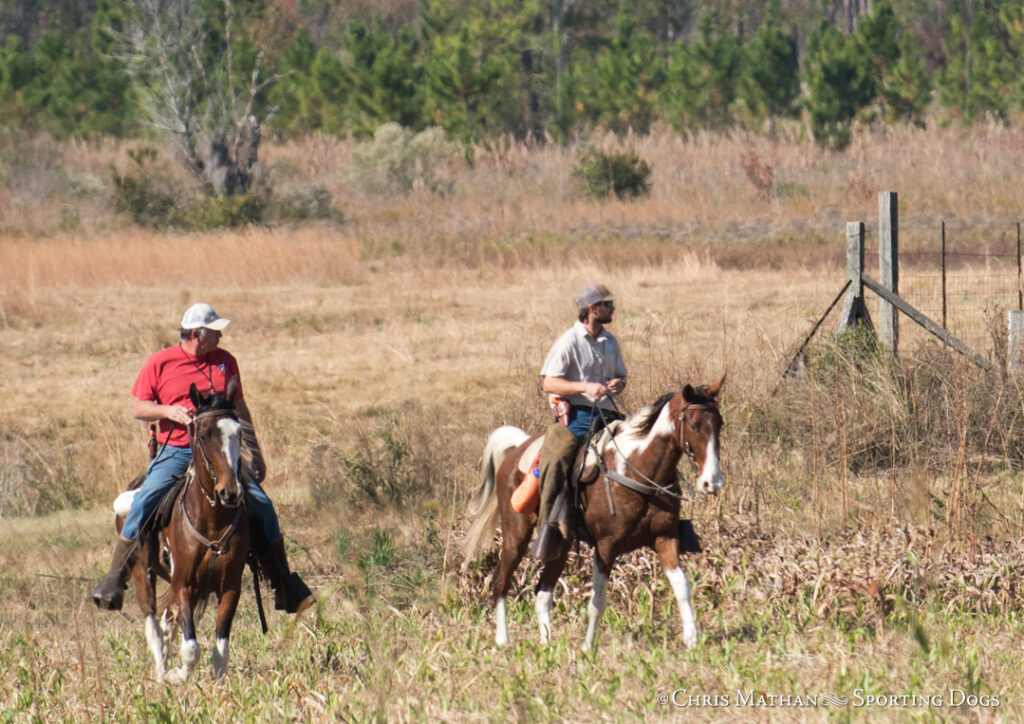
Harley had been a for-the-public trainer-handler thirty years. He’d had some good years, more not so good, when lack of talent or injury or illness of dogs in his string took their toll, or owners he’d counted on lost interest, or went broke, or died. Nothing surprised him anymore. But he still got a thrill when a puppy or derby in his kennel showed promise. That had kept him in the game. His income was meager, but he was frugal, so got by, if barely.
Today was October 10 and he was driving north from North Carolina in his dually, pulling the goose-neck trailer carrying four dog horses and the seven shooting dogs and three derbies that comprised his string. His destination was upstate New York where on a state-owned property he would run the derbies in the shooting dog futurity and the others in a shooting dog championship run on pheasants to follow.
Only one of his four owners would attend the stakes, his newest one, Fred Cole, a greenhorn but enthusiastic. He owned two shooting dogs and one derby, given him by his father-in-law who had been a long-time patron of Harley but could no longer ride, due to the infirmities of age.
Thirty were entered in the futurity. It would be conducted with thirty-minute qualifying braces and one-hour callback finals. He had hopes for one of the derbies, the one owned by the owner who would be riding.
Harley would be trading scouting duties with a fellow veteran based in North Carolina, his regular for the past four years. They were near the same age and had come up in the same era and among the same players in the game. They were friends but not best friends. Friendly rivals probably best described their relationship.
Harley arrived two days before the start of the futurity. He would use the two days to road his string, starting with the derbies. He needed to give them exposure to scenting conditions, quite different from those in the sand hills of his home country where he trained on mixed crop and timberlands owned by absentee investors who luckily bought his pitch that his presence was in their interest, a set of eyes to watch out for mischief, especially wildfires, set intentionally or carelessly. He also supervised controlled-burn fires for them in spring on the training grounds, being certified as qualified for that job.
His owner was waiting when he arrived at the trial grounds, anxious to see his dogs and ask questions of Harley, both about his dogs and field trials. Through the two days Harley patiently answered his many questions.
The stakes had been pre drawn for the convenience of handlers and especially of owners so they could arrange to be present to see their dogs compete. Harley’s owner would be present thorough both stakes, hoping to get much needed lessons on the how-to of the sport. He hoped to be a handler of his dogs in amateur stakes, as his father-in-law had been.
His derby, a handsome male pointer with evenly marked liver mask and no body spots, went down in an early brace, matched with a female setter handled by a young handler in his second year as a pro.
Both dogs would earn callbacks, each keeping the front and scoring a pheasant find apiece with acceptable derby manners. When their brace ended, Harley noticed his bracemate’s mount was limping and called it to his attention. “I know, and he is my only ride. My second horse is home with a split hoof.” His distress was apparent.
“I can lend you a horse for the callback, “Harley said when the heat ended and it was apparent the setter would be called back.
That night Harley’s owner asked him to have dinner with him. While they were enjoying a drink and waiting for steaks, the owner said, “I wish you had not offered a horse to that setter’s handler.”
A chill went down Harley’s spine. All through the meal, Harley brooded about what he would say during dessert. When that time came, he said this.
“Mr. Cole, what you said about my offering a horse to our bracemate’s handler makes me say this. I mean no disrespect by it.” (Harley had detected that Cole, whose father-in-law had told Harley had made a lot of money recently, had a high opinion of himself for it).
“To get along in this game one needs friends. You never know when a competitor can help or hurt your chances. So, when you see a chance to help someone else you should take advantage of it. Also, as you experience the game you will find you enjoy seeing a good dog perform no matter who owns or handles it. If you don’t, you won’t like the game. You are going to lose a lot more often than you win even with a good dog and good luck.”
A long silence followed. Harley realized he was holding his breath. Then Fred Cole said, “Thank you for that, Harley. And call me Fred.”